
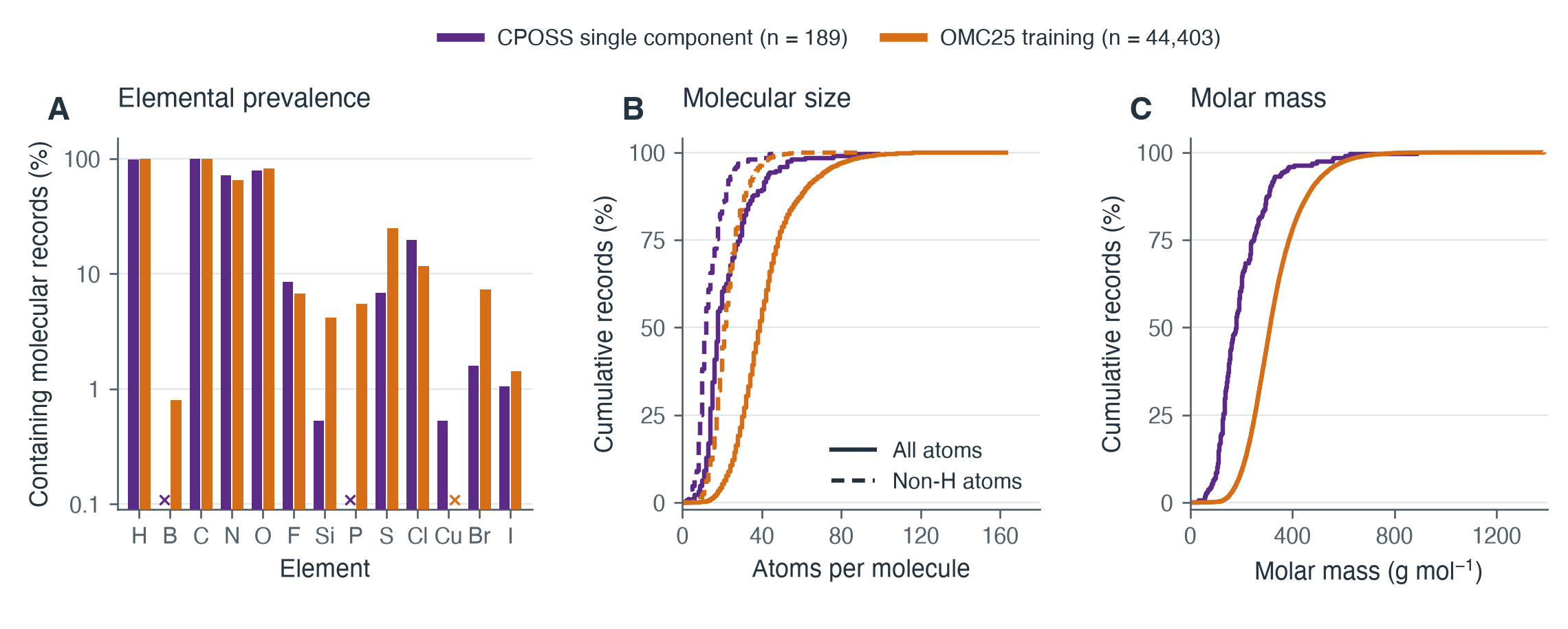
CPOSS and OMC25: chemical content
Elemental prevalence, molecular atom counts and molar-mass distributions for 189 verified single-component CPOSS systems and 44,403 OMC25 training molecular records. Every molecular record receives equal weight.
The CPOSS dataset
The figures, statistics and source data behind the landscapes. Explore molecular diversity, the scope of the archive, and comparisons with OMC25 and the Cambridge Structural Database.
6a77cc47b35fExpand a figure to inspect it, or download the original image, vector PDF, caption and underlying tables.
Elemental prevalence, molecular atom counts and molar-mass distributions for 189 verified single-component CPOSS systems and 44,403 OMC25 training molecular records. Every molecular record receives equal weight.
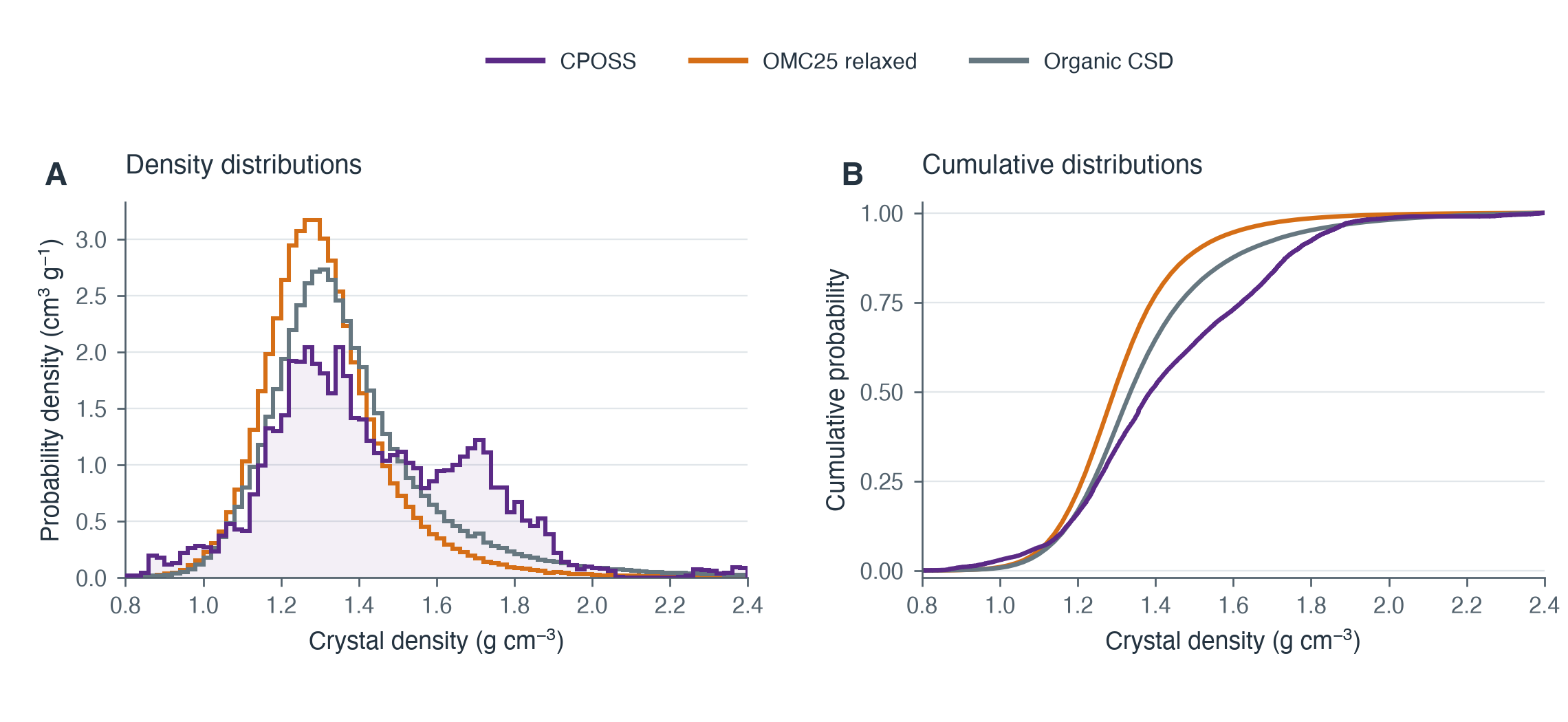
Archive-linked CPOSS density records compared with histogram references recovered from the OMC25 paper. CPOSS systems have equal total weight within the shared 0.8–2.4 g cm⁻³ window; each probability density has unit area.
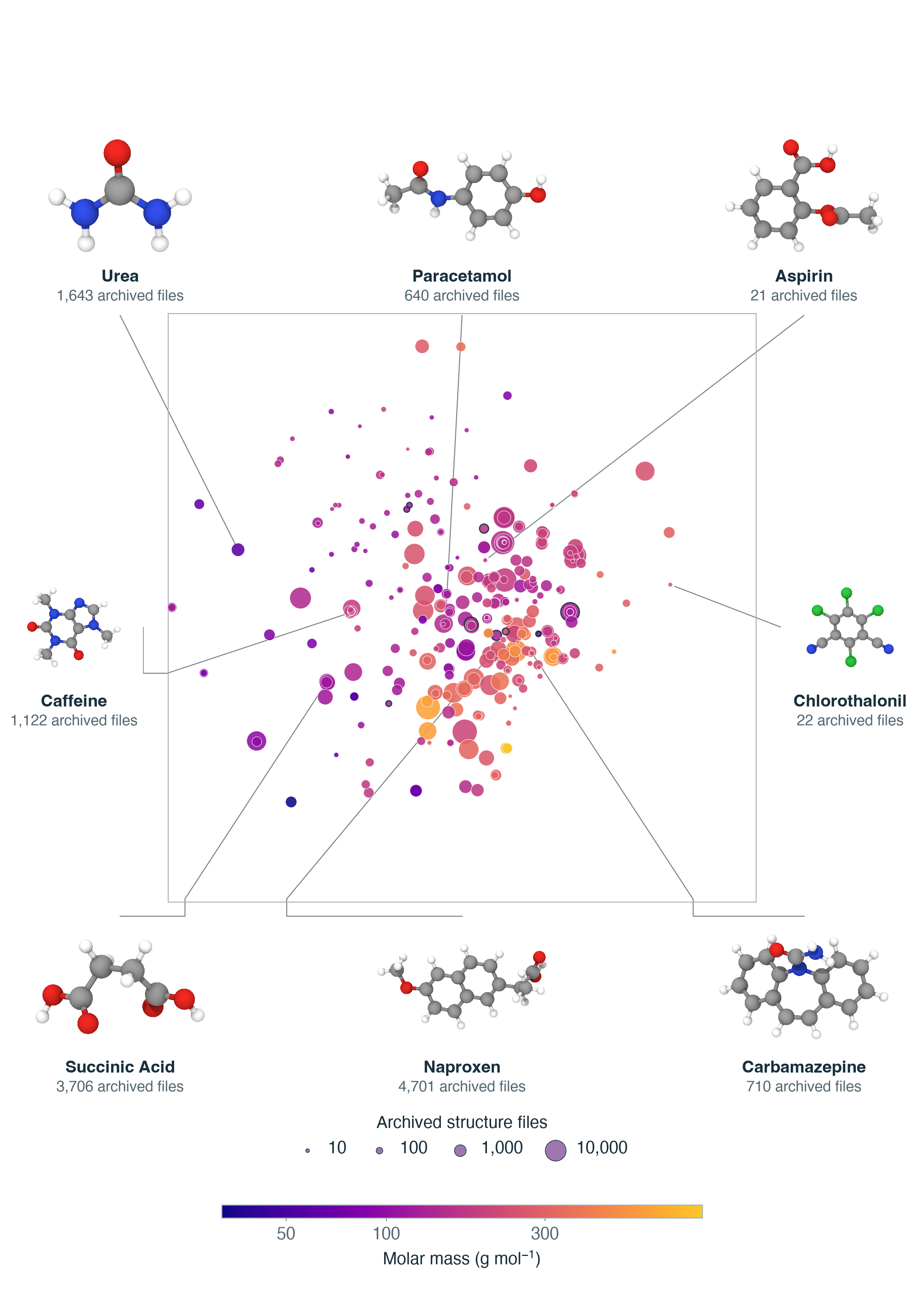
A molecular SOAP sketch-map of 307 current records. Marker area scales with the square root of archived-file count; colour shows representative-component molar mass. Multicomponent systems use their largest non-water component.
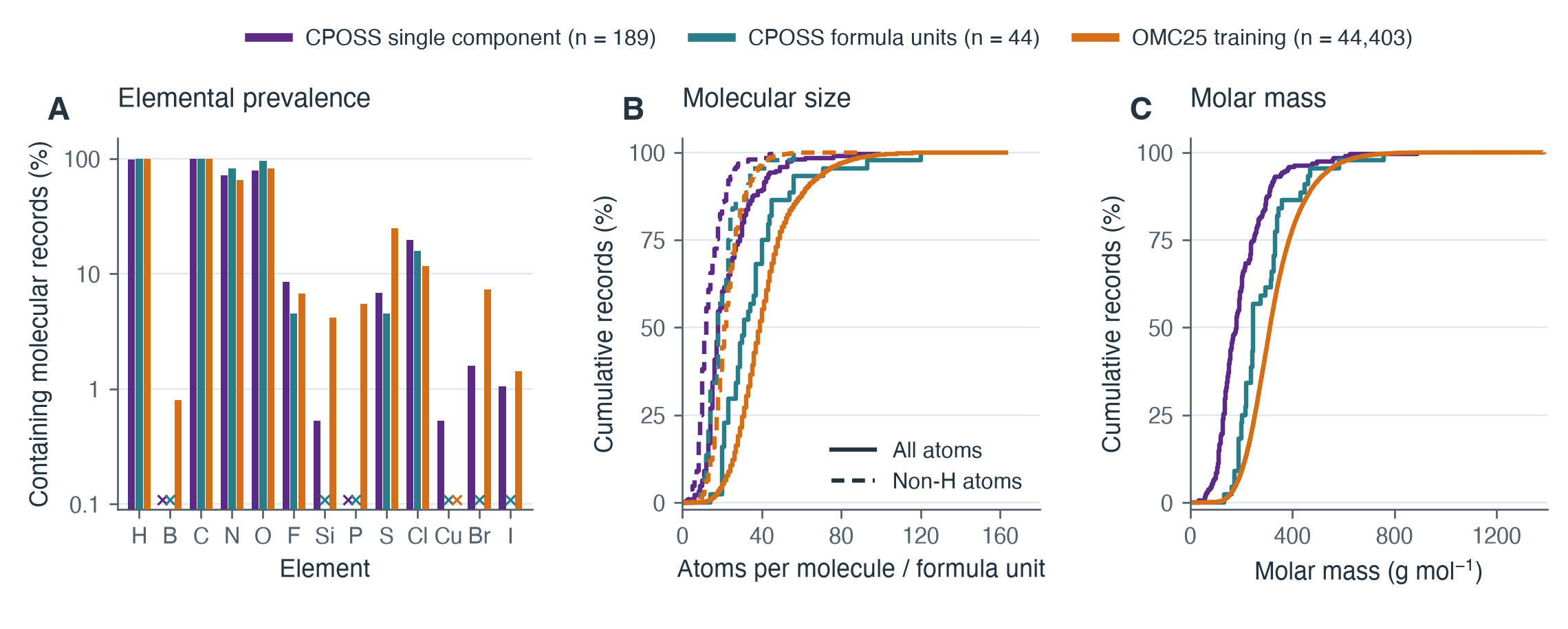
The 44 verified salts, hydrates, solvates and co-crystals are shown separately from the single-component comparison. Atom counts and masses retain all components and stoichiometry of each formula unit.
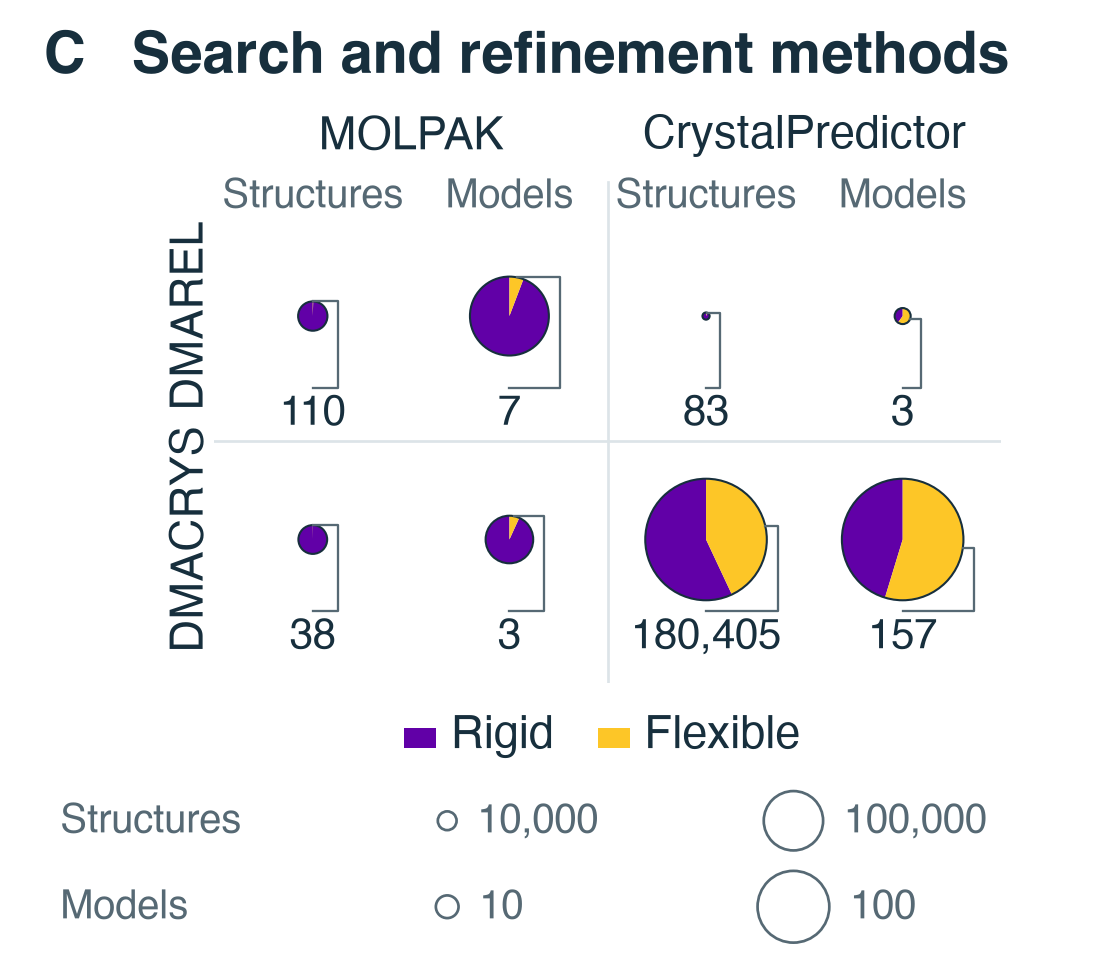
Paired pie charts compare MOLPAK/CrystalPredictor searches with DMAREL/DMACRYS refinement. Purple and gold show rigid and flexible refinement. Structures and models use independent area scales. Includes 457 of 508 models and 468,787 archived records.
Archive totals, source coverage, study history and the people and methods named in the database.
The middle half of searches contain 112.5–1,399.2 archived files. All 310 records have complete archive counts.
| Measurement | Available | Definition |
|---|---|---|
| Archived RES coordinate files | 517,594 | All 508 documented model archives; models counted separately |
| Linked visualization entries | 158,344 | Available Chemiscope exports; can be subsets |
| Archive coverage | 310 / 310 records | Complete file counts for every documented search |
| Single-component systems | 190 metadata / 189 verified | Tetrachlorobenzene remains formula-only |
| Multicomponent systems | 44 / 44 verified | Complete salts, co-crystals, hydrates and solvates |
| Dated searches | 236 / 310 | Single unambiguous study year; release years unavailable |
| Named credits | 285 / 310 searches | 45 scientists; credits can overlap |
| Searches with a linked CSP paper | 192 / 310 | A missing link does not establish that no paper exists |
Visualization entries, spreadsheet rows and archive files describe overlapping scopes and are not added together.
The dated searches contain 488,411 archived files; 29,183 files fall outside the dated series. Study dates do not measure database release or deposition.
| Study year | Searches | Archived files | Cumulative searches |
|---|---|---|---|
| 2003 | 1 | 22 | 1 |
| 2004 | 8 | 357 | 9 |
| 2005 | 23 | 1239 | 32 |
| 2006 | 1 | 79 | 33 |
| 2007 | 4 | 213 | 37 |
| 2008 | 17 | 5388 | 54 |
| 2009 | 13 | 13720 | 67 |
| 2010 | 24 | 52331 | 91 |
| 2011 | 17 | 29227 | 108 |
| 2012 | 16 | 28630 | 124 |
| 2013 | 22 | 48793 | 146 |
| 2014 | 1 | 5855 | 147 |
| 2015 | 12 | 73893 | 159 |
| 2016 | 10 | 15025 | 169 |
| 2017 | 5 | 15605 | 174 |
| 2018 | 27 | 46282 | 201 |
| 2019 | 6 | 35580 | 207 |
| 2020 | 1 | 1827 | 208 |
| 2021 | 11 | 43555 | 219 |
| 2022 | 6 | 3749 | 225 |
| 2023 | 3 | 19990 | 228 |
| 2024 | 6 | 31003 | 234 |
| 2025 | 2 | 16048 | 236 |
| Publication year | New linked CSP papers | Cumulative CSP papers |
|---|---|---|
| 2004 | 4 | 4 |
| 2005 | 6 | 10 |
| 2006 | 3 | 13 |
| 2007 | 2 | 15 |
| 2008 | 7 | 22 |
| 2009 | 3 | 25 |
| 2010 | 3 | 28 |
| 2011 | 8 | 36 |
| 2012 | 5 | 41 |
| 2013 | 4 | 45 |
| 2014 | 3 | 48 |
| 2015 | 2 | 50 |
| 2016 | 4 | 54 |
| 2017 | 3 | 57 |
| 2018 | 3 | 60 |
| 2019 | 4 | 64 |
| 2020 | 2 | 66 |
| 2021 | 4 | 70 |
| 2022 | 2 | 72 |
| 2023 | 1 | 73 |
| 2024 | 2 | 75 |
The paired pies show archived structure records and equally weighted energy models. Each measure has its own area scale; purple denotes rigid refinement and gold flexible refinement.
468,787 of 517,594 records and 457 of 508 models are classified. The remaining 51 models / 48,807 records lie outside the matrix or remain unresolved. Structure records retain separate energy-model representations.
Download matrix counts ↓| Category | Searches |
|---|---|
| FIT | 280 |
| Williams | 35 |
| Day / Rice | 22 |
| Non-empirical / SAPT | 4 |
| Custom Delaware | 1 |
Categories overlap; each search counts at most once per category.
| Category | Searches |
|---|---|
| MP2 | 175 |
| PBE0 / PBE1PBE | 109 |
| HF / SCF | 41 |
| M06-2X | 12 |
| DFTB3-D3 | 11 |
| B3LYP | 10 |
| B3PW91 | 3 |
| CCSD | 2 |
| PBE | 2 |
Categories overlap; each search counts at most once per category.
285 searches name at least one scientist. Credits overlap and follow the source Scientist field; paper authorship is recorded separately.
| Named scientist | Credited searches |
|---|---|
| Louise Price | 65 |
| Tom Lewis | 22 |
| Panos Karamertzanis | 20 |
| Nizar Issa | 18 |
| Doris Braun | 17 |
| Rui Guo | 14 |
| Matthew Habgood | 14 |
| Luca Iuzzolino | 13 |
| Sarah Barnett | 13 |
| Ashley Hulme | 13 |
| Sharmarke Mohamed | 12 |
| Sally Price | 12 |
| Agris Berzins | 12 |
| Emiliana D'Oria | 8 |
| Joe Ridout | 8 |
| Anastasia Ntantou | 7 |
| Yiming Ding | 5 |
| Antonio Torrisi | 4 |
| Weijia Zhu | 4 |
| Rebecca Hylton | 4 |
| Harriott Nowell | 3 |
| Salima Ismail | 3 |
| Ogaga Uzoh | 3 |
| Gareth Welch | 2 |
| Rona Watson | 2 |
| Alston Misquitta | 2 |
| William Wood | 2 |
| Dave Case | 2 |
| Alex Aina | 2 |
| Einat Schur | 2 |
| Juliette Pradon | 2 |
| Andrei Kazantsev | 1 |
| Tinoziva Sango | 1 |
| Stephen Tendyra | 1 |
| Shihao Ying | 1 |
| Helen Tsui | 1 |
| Ricarda Duss | 1 |
| Binal Patel | 1 |
| Isaac Sugden | 1 |
| Eric Stevenson | 1 |
| Bob Lancaster | 1 |
| Carole Ouvrard | 1 |
| Michael Lawrence | 1 |
| Merina Corpinot | 1 |
| Pinky Pridhanani-Jethani | 1 |
192 searches link a qualifying CSP paper. References are deduplicated by DOI or canonical URL; experimental-context references are recorded separately.
Equal weight per documented molecular record: 189 verified single-component CPOSS systems and 44,403 OMC25 training molecular records.
| Variable | CPOSS median (range) | OMC25 median (range) |
|---|---|---|
| Atoms per molecule | 18 (5–100) | 39 (4–164) |
| Non-H atoms per molecule | 12 (2–48) | 21 (2–92) |
| Molar mass (g mol⁻¹) | 180.16 (32.04–890.88) | 312.15 (30.03–1,386.32) |
The observed CPOSS single-component size and mass ranges lie within OMC25’s ranges. Range overlap does not establish matching chemical environments or crystal packings.
The other 44 verified CPOSS systems are complete multicomponent formula units. They retain coformers, counterions and water; their masses are not single-molecule masses. One additional single-component system remains in the formula-only sensitivity population.
Molar masses use one frozen average-atomic-weight convention. Original OMC25 masses are retained; harmonization changes a training mass by at most 0.032 g mol⁻¹.
| Element | CPOSS: percentage (count/N) | OMC25: percentage (count/N) |
|---|---|---|
| H | 98.41% (186/189) | 99.65% (44,248/44,403) |
| B | 0.00% (0/189) | 0.80% (354/44,403) |
| C | 100.00% (189/189) | 99.98% (44,393/44,403) |
| N | 71.43% (135/189) | 65.36% (29,021/44,403) |
| O | 78.84% (149/189) | 81.88% (36,356/44,403) |
| F | 8.47% (16/189) | 6.73% (2,989/44,403) |
| Si | 0.53% (1/189) | 4.18% (1,855/44,403) |
| P | 0.00% (0/189) | 5.50% (2,444/44,403) |
| S | 6.88% (13/189) | 24.82% (11,019/44,403) |
| Cl | 19.58% (37/189) | 11.65% (5,175/44,403) |
| Cu | 0.53% (1/189) | 0.00% (0/44,403) |
| Br | 1.59% (3/189) | 7.31% (3,245/44,403) |
| I | 1.06% (2/189) | 1.42% (630/44,403) |
A record contributes once to every element it contains. These overlapping percentages do not sum to 100%. Cu occurs in CPOSS and is outside the OMC25 elemental vocabulary.
CPOSS source-reported densities compared with the last-frame OMC25 and organic CSD references from Figure 3a of the OMC25 paper.
| Population | Median | Q1 | Q3 | Mean |
|---|---|---|---|---|
| CPOSS: per record | 1.35 | 1.24 | 1.52 | 1.38 |
| CPOSS: equal weight per system | 1.39 | 1.25 | 1.62 | 1.43 |
| OMC25: last frames (≈) | 1.29 | 1.21 | 1.39 | 1.31 |
| Organic CSD reference (≈) | 1.34 | 1.24 | 1.46 | 1.38 |
All values are in g cm⁻³ and conditional on the shared interval. OMC25 and CSD values are approximate histogram recoveries, not statistics calculated from raw crystal records.
113,265 records from 258 searches lie in the comparison window. 0.89% lie outside it and remain in the data tables.
Each search contributes one archive-linked density column. The CPOSS curves give each molecular system equal total weight within the shared window, with equal weights for its represented searches. This prevents systems with more stored candidates from dominating. OMC25 and CSD are independently normalized histogram references; their molecular-system identities are unavailable for reweighting.
This visualization subset is not a density census of all 517,594 archived files. Density agreement does not establish equal chemical, packing or stability coverage.